Saturday, December 12, 2009

Google Caffeine and the New Ranking Factors

Google Caffeine is the name given to Google's "Next Generation" search engine, which it will use to rank and index all the pages on the wonderful world wide web. According to all indications, this is not just another one of Google's infamous Updates, but a major "Overhaul" of its index and algorithm - the complex formula and calculations Google uses to rank all web pages, including yours. 

If that doesn't sound ominous enough, according to Matt Cutts (Google Spokesperson) one database is already showing Google Caffeine, and the full blown version will be released after the holidays. The reasoning behind this - Google doesn't want to upset webmasters and site owners during the lucrative holiday buying season. In the past, other major Google Updates have come around this time of the year, most notably the "Florida Update" which severely affected many web sites and webmasters.


Recently, Google has been more aware and much more generous to webmasters by being more open and forthcoming in regards to how it indexes its pages. This time around, webmasters were even given access to a beta version of Caffeine which Google released last summer ('09) where webmasters could check to see how well their keywords and site would fare in this new search index. This beta site (www2.sandbox.google.com) has now been taken down by Google. 

Like any professional search engine marketer who works online, I was constantly checking my sites and keywords in Google's new search engine. I have drawn some conclusions from what I have observed, but please be aware it is often very foolish to draw conclusions and make predictions from a small sampling of results. You can end up with egg on your face very quickly, especially when you consider Google is probably still making adjustments and refinements on Caffeine as it analyzes the results. 

However, there are certain ranking factors that even Google is telling us about, mainly "Site Speed" or how fast your site loads will play a part in how its ranked. We have also heard a lot about "Broken Links" and if your page or site has them, then it will probably be ranked lower. Of course, linking out to "Bad Neighborhoods" will probably still not be a good practice, if you want higher rankings within Google. 

It should not come as a shock or a surprise, that "Over-All Page Quality" will play a greater role in how well your page ranks. Keep in mind, Google is like any other company putting out a product, if that product doesn't have a high standard of quality, it reflects badly back on everybody concerned. Google's SERPs (Search Engine Results Pages) are the key to all their online revenue, they must do everything in their power to keep that product fast, relevant, current and above all high quality.

Therefore, expect "OnPage Factors" to play a much greater role in Google Caffeine. Quality unique content, page design, good navigation, title, meta tags, description, keyword density, alt tags, page views, bounce rate, traffic numbers, time spent on page, and the number of social bookmarks may play an increased role in achieving high rankings. A perfectly optimized keyworded page, with the keyword in the title, description, meta tags, alt tags, on the page... will probably get you ranked higher in Caffeine, as well as most search engines on the web.


This may be pure speculation on my part, but one of the areas Caffeine will be addressing or incorporating is "Social BookMarking", that is the number of social bookmarks a page receives will determine how high it is ranked. I also believe one of the major reasons these bookmarks will become much more important has to do with the whole nasty issue of link buying.

Now, the integrity of Google's index is not in question, but any savvy marketer or webmaster knows any individual or company with deep pockets and huge resources can buy their way into the top spot. Despite Google's attempt to stop it, link buying and keyword positioning, is a thriving industry on the web. Rightly or wrongly, money and unlimíted resources will get you or your company to the top in organic search, regardless of which search engine you're targeting.

All moral and ethnical issues aside, the small webmaster and/or online marketer is stuck right in the middle, with Google on one side and these major multinational competitors on the other. Looming on the horizon is Google Caffeine, a new sheriff in town!

What New Rules Will This Sheriff Bring?

The major question here is this: has the importance of backlinking been downplayed in this new index in favor of the keyworded domain and onsite content and optimization? Has there been a major shift to listing more quality content rather than relying on the number of backlinks a site is receiving, even from important related themed sites? The major problem and question to Google is this: if links can be bought, how do you keep your organic results democratic and fair, which was the original intention of Larry Page and Sergey Brin when they started Google in 1998.


One Possible Solution is Social Bookmarking

Will we see an ever growing importance of social bookmarks and links in this new index. It is quite easy to buy 1000 links, but getting 1000 or 10,000 "re-tweets" is a little more difficult. Similarly, getting two or three thousand "diggs" may be a little harder to pull off. Same goes for Del.icio.us bookmarks, Facebook fans... well you get the picture. Will Google's use of these new social sites make Caffeine faster, more relevant, more current and most importantly of all, can it bring some democracy back into their index?

Of course, nothing in Google's new index will be that cut and dry, that black and white. Other ranking factors such as age of site, past history and reputation, traffic numbers, authority branding... will all play a role in whether your site gets listed on that all important first page. However, on page factors may play a greater role - title, meta tags, description, keyword density, alt tags, page views, bounce rate, time spent on page, and the number of social bookmarks may play an increased role in achieving high rankings. Website speed or how fast your site loads may also be a new ranking factor.

Underlying this whole issue is the fact which many experienced webmasters/marketers already know, Google's SERPs are not a one-trick pony anymore. For very lucrative (monetized) keyword phrases, Google's results are broken up into Five categories... Info listings, Video listings, News Listings, Shopping Listings and Corporate Listings. Forget Caffeine, this is probably the fairest move Google has made in the last few years to make its SERPs more democratic.

Another even more puzzling issue for me concerning Google Caffeine is how much emphasis or ranking power will it place on "Keyworded Domains", domain names which have your keyword or keyword phrase in them. Will these domains be ranked higher? Webmasters and marketers for years have been telling us we should always pick domain names which have our major keywords in them. Just common sense really, someone searching for "brown widgets" will more likely than not find that item at a domain called brownwidgets(dot)com or brownwidget(dot)com. The major SEO reasoning, all your backlinks will inherently have your searched keyword in the URL, thus bringing it up in the rankings.

Yahoo, Microsoft Close Search Deal

It’s somewhat ceremonial, but also an important milestone: Yahoo and Microsoft have announced the finalization and execution of the search deal that was first announced in late July.
The companies issued this statement:
“Microsoft and Yahoo! believe that this deal will create a sustainable and more compelling alternative in search that can provide consumers, advertisers and publishers real choice, better value, and more innovation.
“Yahoo! and Microsoft welcome the broad support the deal has received from key players in the advertising industry and remain hopeful that the closing of the transaction can occur in early 2010.”
While the deal still faces regulatory approval, today’s announcement means Microsoft and Yahoo can now move forward with their integration plans. Officials in Canada and Australia have already signed off on the agreement.

Yahoo Launches Ad Interest Manager

Yahoo has just rolled out its Ad Interest Manager which according to Yahoo is a new consumer tool which aims to make online advertising, particularly interest-based more transparent.  This, according to Yahoo is one way of building up user trust. The Ad Interest Manager site lets you see a concise summary of your online activity on Yahoo’s content network, so much so that you can determine your level of exposure to interest-based ad served by Yahoo Ad Network.
Screen shot 2009-12-07 at 8.05.44 PM
Anne Toth, Yahoo VP for Policy and Head of Privacy, said that Ad Interest Manager will provide Yahoo users/visitors transparency into how Yahoo’s interest-based advertising works as he emphasized that users can opt-out of Yahoo’s  interest-based ad targeting.
“Yahoo! is committed to providing consumers with increased transparency and control when they are online. Ad Interest Manager will show users what interests we think they have, and also let them edit and change those interests to reflect the most up-to-date information.”
Specifically, Yahoo’s Ad Interest Manager Tool :
  • Provides a central point where Yahoo! visitors can assert even greater control over their online experience.
  • Gives visitors an unparalleled view into the information used to deliver interest-based advertising.
  • Shows the visitor both Yahoo!’s educated guesses about their interests and a summary of observations, along with other information they have provided.
  • Provides a list of specific interest categories that Yahoo! has placed a user into and lets people turn those categories off.
  • Allows people who don’t want to see interest-based ads to turn them off entirely.
If you want to opt out of this program, check out the Ad Interest Manager site. Be sure to allow cookies from Yahoo and you must be logged in to your Yahoo account too.

Google Analytics Rolls Out More Great Features

Google continues to improve  its Analytics service by introducing some more great features namely – annotations, custom variables, new tracking code setup wizard and a new version of the Google Analytics API.In brief, here’s what each of these new features will let you do on your Google Analytics account.
googleanalyticsannotatiosn
Annotations – Lets you leave shared or private notes right on the over-the-time graph of any Google Analytics account which you have been granted access to. This is useful for company analytics account which is being shared among several members of the company. Each of these members can leave comments whenever a significant spike or downturn is experience by the company’s website as recorded by Google Analytics.
Custom Variables in Advanced Segments – Lets you create advanced segmentation based on any key, value or a combination of all custom variables. You can see this advance segment across all your Analytics report.
Custom Variables in Custom Reports – lets you create custom reports with any of the key or value dimensions that are associated with any custom variable. This is useful for seeing how a custom variable segment behaves on Google Analytics’ metrics.
New Analytics Tracking Code Setup Wizard – automatically generates appropriate tracking code based on the setup options you specify.
New Google Analytics API – new features will be announced later this including support for advanced segmentation.

Google Caffeine: how will it affect the rankings of your web pages?

Google Caffeine is the name given to Google's next algorithm update that is going live after the holidays. It seems that Google Caffeine will be more than Google's regular updates. It will probably be a major overhaul of the calculations that Google uses to rank web pages.
Caffeine


What is going to change?

Of course, Google hasn't revealed the details of Google Caffeine yet. However, the new index has been live on some test servers and some Google employees also talked about the next index. The following factors might play a larger role in Google's next index:
  • Website speed: if you have a slow loading website, it might not get high rankings on Google.

  • Broken links: if your website contains many broken links, this might have a negative impact of the position of your web pages in Google search results.

  • Bad neighborhoods: Linking to known spammers and getting a lot of links from known spammers isn't good for your rankings in Google's current algorithm. The negative impact of a bad neighborhood will probably be even worse with Google Caffeine.

  • The over-all quality of your website: Google's new algorithm probably will take a closer look at the over-all quality of your website. It's not enough to have one or two ranking factors in place.

    You'll probably need good optimized content, a good website design with a clear navigation, good inbound links, a low bounce rate, etc. The number of social bookmarks might also play an increased role.
Factors like the age of a website, its past history, authority etc. will still play a role in Google's new index. However, the effect of the different factors on your rankings will shift.
How can you adjust your web pages to Google's new Caffeine index?
Although Google's Caffeine update hasn't been release yet, there are some things that you can do to increase the chances that your website will get good rankings in Google's new index:
  • Remove all spam elements from your web pages. Anything that might be considered spam can and will have a negative effect on the position of your web pages sooner or later. This includes text that has nearly the same color as the background, cloaking and fully automated linking systems.


  • Check your website design and the navigation of your website. Your website should have a professional look and feel. The navigation should be easy to understand and your web pages should easily be parseable by search engine spiders. You can test this with the search engine spider simulator in IBP (Select Tools > Search Engine Spider Simulator in IBP's main window).


  • Get links from social bookmark websites. Social bookmark links already play a role in Google's current algorithm and that role might increase.


  • Check your links. You shouldn't link to websites that look like spammers. It's better to focus on selected quality links instead of as many links as possible.
Google Caffeine is going to be released after the holidays. If you follow the tips above, your website will be in a good position when Google's new index will be online.

Website Traffic Generation Planning and Methodologies

Real Estate internet marketing is like any other kind of marketing, you're trying to reach a niche market and must plan accordingly. You have to start by identifying your target market in order to develop your message conveying exactly the kind of high value business proposition which your niche will respond to.

The first steps are to:

     1) Identify your target market; start with geo targeting and work with the demographics from there.

     2) Decide how you want to be perceived by this target market and decide how you'll foster this
         perception.

     3) Identify and refine your value proposition.

 Once you've done this, the next step is to develop and distribute your value proposition, making sure that your value proposition is perceived by your target market exactly as intended. In marketing, shaping consumer perception isn't just the most important thing: it's everything.

You have to start by positioning yourself to be perceived in a specific way; from here, you'll need to maintain, develop, grow or alter this market position as you deem necessary.

The real challenge is putting these principles into action:

Driving Traffic

There are some important principles of traffic generation you need to understand in order to be successful at bringing visitors into your website.

There are both principles and rules of traffic generation; principles have to do with your approach to the task and the rules are the practical nuts and bolts of driving traffic. You need to have an understanding of the larger picture before you can successfully put the practical techniques into action.

What you'll usually see a lot of is the techniques alone. While this is still valuable information, you probably won't get far with these techniques if you aren't versed in the underlying principles of traffic generation.

These are the most important principles of traffic generation:
• Traffic generation isn't a black art - it's something which largely relies on common sense and methods which can be replicated with consistent results.

• The reason people usually fail in their traffic generation efforts is that they don't truly commit to making traffic generation techniques a fully integrated part of their business strategy.

• You need to create a plan for driving traffic. Think of it as a road map; follow it, but remember that it's not carved in stone. Your plan can and should evolve to reflect your real life experience and results.
 • Continually test and track the results of your traffic generation efforts - and adjust your plan accordingly.

• Set goals for yourself and as you meet them, raise the bar; traffic generation is a process, not a single objective.

• Don't be discouraged if you don't see results immediately.

• Remember that driving traffic begins with building your site - Why is this? Because your site should be built from the ground up with visitors in mind. Look at other sites in your industry to gain an understanding of patterns of visitor behavior.
See what these other sites are doing; don't hesitate to take a page from your competition's playbook if you see something which is working for them.

This is where things can become challenging; it's something like standing in Grand Central Station at rush hour with a megaphone, trying to be heard above the noise of the crowd. The goal here is to get the attention of your target market and get them to come to your site.

All business is arbitrage. You're taking something which is cheap (to you, at least) and exchanging it for something of higher value - buy low, sell high.
 For example, SEO and other free traffic generation strategies essentially trade your time for traffic which is of higher value to you; this value may be measured directly in monetary terms or in other means (for instance, as signups to a list). The same is true of paid methods of driving traffic like PPC advertising; you're paying what you deem to be a small amount for something else which you see as more valuable.

If you've been reading carefully so far, you may have noticed that I haven't said a word about being indexed by the search engines; that's because this falls under the heading of techniques, not the principles of traffic generation. While you do of course want to be indexed, this isn't your primary objective - and it's something which will happen naturally as you work to drive traffic using other strategies.

Don't lose sleep over the search engine crawlers; they will come sooner or later. Remember that even once your site is indexed, there's no assurance that visitors will follow. Focusing on being indexed is losing sight of the forest for the trees. This will happen anyway as a side effect of using other traffic generation methods. What you should be focused on is getting targeted traffíc to your site. For instance, if you exchange links with another site (or even a directory) relevant to your industry, the search engine crawlers will follow these links when indexing this other site and voila! Your site will be indexed.

What you need to do is to let the web know that your site is there while simultaneously driving targeted traffíc. The best way to do so is to create links to your site from other sites; not only do these result in your site being indexed, but back links are great SEO and of course, they can generate traffic directly through visitor clicks.

Resource for Checking Your SEO Content Readability

There was an interesting idea in the post I stumbled across last week that the readability level may affect your rankings because…
from a logical standpoint, having reading level as a ranking factor among the search engines just makes sense. It’s a good way to match the right content with the right audience.
I never did any testing to confirm that, nor was readability check ever part of my SEO process but it does make sense. So in case you ever need to find out how readable your content is, let me offer you a one-stop overview of readability level checkers and comparison tools.

Readability Level Tests

Readability test name
Parameters to take into account
The score corresponds to…
Flesch–Kincaid readability test
total words versus total sentences; total syllables versus total words
U.S. grade level
Coleman-Liau Index
Characters versus words; Sentences versus words
U.S. grade level
Automated Readability Index
characters per word; words per sentence
U.S. grade level
Gunning fog index
words per sentence; complex word per total number of words (complex = words with three or more syllables with some exceptions like proper names or words with common suffixes -es, ed, etc)
U.S. grade level
SMOG
Number of polysyllables (three or more syllables excluding proper names) versus number of sentences
years of education needed to completely understand a piece of writing
A handy tip: if you are not in the USA (like myself) and it takes some serious effort to translate the US grade system, U.S. grade level 1 corresponds to age 6, and in general adding 5 to the grade level gives an estimate of the typical reader’s age.
The page I was playing with to try readability level checkers: NYTimes article. So let’s take a look at readability tools:

Free Readability Level Checking Tools

Readability tool
Type
Readability test(s) the tool is based on
Parameters taken into account
Issues
Fog
online
Gunning fog index
Number of words, number of sentences
Includes proper names
SMOG
online
SMOG test
Number of polysyllables, number of sentences
-
Flesh
desktop
Flesch–Kincaid readability test
total words versus total sentences; total syllables versus total words
-
Readability score
online
Flesch-Kincaid Grade Level, Gunning-Fog Score, Coleman-Liau Index, SMOG Index, Automated Readability Index
-
-
Edit Central
online
Flesch reading ease score, Automated readability index, Flesch-Kincaid grade level, Coleman-Liau index, Gunning fog index, SMOG index
-
-
Read-able
online
Flesch reading ease score, Automated readability index, Flesch-Kincaid grade level, Coleman-Liau index, Gunning fog index, SMOG index
-
Includes proper names
Online readability test
online
Coleman Liau index,
Flesh Kincaid Grade level, ARI (Automated Readability Index), SMOG
-
-
uicy Studio Readability Test
online
-
-
[I described some of the tools in more detail below]

Fog

Fog tool (as the name suggests) uses Gunning fog index to calculate the text reading level. The best things about the tool are:
  • It highlights the “complex” words (those that have more than 3 syllables in blue);
  • Marks separate sentences.
This looks really useful for visualizing “difficult” spots in your text to make it clear if you need any edits:
Fog Test

Readability score

Readability score is a nice way to compare all the listed readability tests (Flesch-Kincaid Grade Level, Gunning-Fog Score, Coleman-Liau Index, SMOG Index, Automated Readability Index):
Readability tool

Edit Central

Edit Central is another handy tool that compares a number of readability tests, shows useful stats and also underlines complex words:
Edit Central

Juicy Studio Readability Test

Juicy Studio Readability Test displays some really useful page copy stats including average length of a sentence, complex words, etc:
Readability test

Google Chrome for Mac, Linux Available Now

As an early Christmas gift to us Mac users who have been waiting for so long, Google has finally outed Chrome for Mac (beta).  As a bonus, Google has also released Chrome for Linux and activated Chrome Extensions for Chrome users in Windows platform. If you’re a Mac user and you haven’t downloaded Chrome Beta for Mac, you should – right now.
Screen shot 2009-12-09 at 3.53.28 AM
Google Chrome for Mac (Beta) brings the clean and simple design and of  course the lightning speed of Google Chrome that Windows users have been enjoying for the past couple of months now.  Like what the Google Blog said, Chrome for Mac loads fast, as in really fast.  In terms and look and feel, Chrome for Mac (Beta) is different of course from Chrome on Windows. It’s more  like having a toned-down version of Safari.
Some of the basic features of Chrome for Windows are already in Chrome for Mac, although advanced features such as bookmark sync, extensions, bookmark manager are yet to be incorporated. Browser skins are already available.
Overall, Chrome for Mac looks pretty good. It’s still in beta so expect some glitches along the way, although so far I haven’t encountered any. Hopefully  more advanced features would come along the way.
You may download Google Chrome for Mac (Beta) from here.
Aside from releasing Google Chrome for Mac (Beta), Google also made Chrome for Linux (Beta) available for Download with support for the 300 cool Chrome extensions which are also available for use on Google Chrome for Windows installation.

Google Penalties – Questions and Answers by Ross Dunn

A picture of a brick wall with barred windows and the words "YOU in GoogleJail" - "How to get out on good behaviour"


Question 1) My site has been penalized by google coz of paid post and links, which left my site with a PR 0, do you have any suggestions for that?”
Ross Dunn: Yes, the best way to go is to have all of the paid posts and links removed; if that has not happened already. Then once you are certain you are no longer infringing on Google’s guidelines, go into your Google Webmaster Tools account and submit a request for reconsideration of your website; if you can’t find the area to do that, then just do a quick search in the help area and you will find it.
Unfortunately there is no guarantee this will get you back into Google’s graces and there is also no telling how long Google will take to even get to your request, however, it is an excellent first step. The next step is to build your site into a powerhouse of excellent information by creating a blog or getting more active in the one you have. This involves posting original, high quality content that provides potential readers with something of value – be it simply an enjoyable read or useful tips. The act of building your site’s reputation through new quality content will help your odds of getting back into Google’s graces considerably.
Question 2) “I am eager to know if we go for URL removal request and make changes to site and then again submit link to google.Does it faster way to get out from penalization?”
Ross Dunn: No, although I can’t say I have tried such an option, my opinion is that removing your URL will not speed anything up because Google will retain the historical profile of the domain – including its transgressions.
Question 3) “What are other penalties that could still exist? Like content duplication, same meta tags for all pages, bad neighborhood, etc. If you have any resources that provides information on “Google Penalties” than it would be great to share with SEO community.”
Ross Dunn: Content duplication is not met with a penalty per se unless the site in question is 100% duplicate content at which point it might as well be penalized since Google will have little or no interest in it. There are a few exceptions to that such as news aggregate websites which are, by definition entirely duplicate-content-driven.
As for duplication of Metas and Titles… that is just going to harm you in terms of on-page optimization but it will not incur any sort of Google penalty unless, of course, the tags are full of SPAM but that should be a given to most novice SEOs.


Bad neighborhoods is an entirely different thing altogether because it really depends what you mean by that. If you have links predominantly from “bad neighborhoods” then it is quite possible Google will go beyond just negating the benefit of the links to actually penalizing your site because it will appear as though you are trying to game Google’s trust algorithms. If you mean being hosted on a server where you share the ip address with some bad neighborhoods… well that is a little more difficult to prove but I expect it can be a problem.


If you have any more questions please do not hesitate to contact me via our contact form or request a quote for some consulting to get your Google penalty turned around and your site back on the path to top search engine rankings.

The Importance of HTML Sitemaps

In my opinion an HTML sitemap is one of the most important tactics you can use to distribute your link juice efficiently within your site. Yet many bloggers and webmasters neglect it. In this article I will explain how the HTML sitemap works, and also give you a hot tip you can use to boost your search engine optimization.

First things first, what is an HTML sitemap? It is an actual page of your website that outlines the complete structure of your site, and that links to all the important pages on your site.

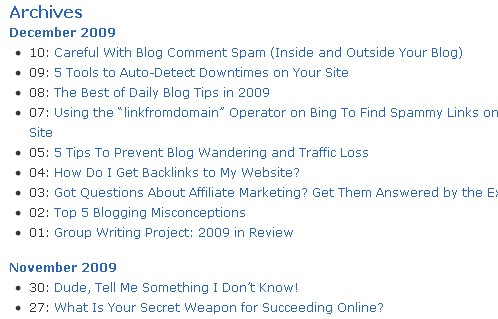
If you want to see an example, check the Archives section of my blog. I call it “Archives”, but that is nothing more than an HTML sitemap, because it outlines the structure of all the posts I have published  there month by month, and it also links to all of them.

html sitemap

Now it is important to not confuse an HTML sitemap with an XML one. An XML sitemap also outlines the structures of your site, but the  XML format is understood by search engine bots only. If you visit an XML sitemap you will just see a bunch of code.

XML sitemaps are useful if you are having crawling or indexation problems on your site. That is, if search engine bots are not visiting or indexing your pages correctly. If you are not having such problems, however, having an XML sitemap is not essential.

The HTML sitemap, on the other had, can be very useful no matter what. First of all because it is valuable for human visitors, as it allows them to find any page within your site quickly. Second, and most important, HTML sitemaps represent a very efficient way to distribute your link juice among the pages of your site.

Ideally you want to have all the pages linking to the HTML sitemap and the HTML sitemap linking back to all the pages (you can exclude non important pages like the privacy policy or contact page if you want). One way to accomplish this is to put a link to the HTML sitemap on the main navigation menu or on the footer of your site.

Finally, here is the hot tip that I promised: getting external backlinks pointing to your HTML sitemap can be very good to your search engine optimization. Why? Because that link juice will pass directly to all the pages on your site. If you get a backlink pointing to an internal page (e.g., a blog post) it will need to pass through at least one hop before it passes juice to other pages. Links to the HTML sitemap, on the other hand, pass juice directly to all other pages on your site.

The next time you do a guest post, therefore, consider pointing the byline link to your HTML sitemap instead of your homepage.